Tord Foleson and Aalov Einarsdotter
Tord Foleson
27th Great Grandfather
b. Abt. 988, More og Romsdal, Norway
d. July 29, 1030, Stiklestad, Nord-Trondelag, Norway
Aalov Einarsdotter
27th Great Grandmother
b. Abt. 991, Trondheim, Sor-Trondelag, Norway
d. 1031, Stiklestad, Nord-Trondelag, Norway
Aalov Einarsdotter is the daughter of Einar Eindrideson Tambarskjelve who was an influential Norwegian noble and politician during the 11th century. He headed the feudal lords in their opposition to Olav Haraldsson. She is the grandaughter of Haakon Sigurdson, Jarl of Hladr and Protector of Norway.
Tord Foleson is known from the Battle of Stiklestad where he was standard bearer for King Olav Haraldsson. Tord Foleson was able to plant the banner before he died, and it remained standing throughout the battle, even after the king fell. It was kept erect and replaced by the local populace for centuries, and a memorial stands at the site today.
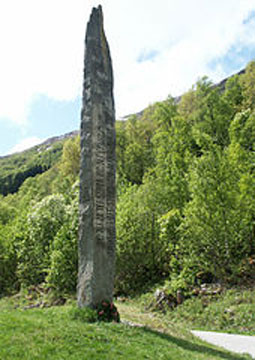
Memorial at Stalheim
Battle of Stiklestad
The Battle of Stiklestad in 1030 is one of the most famous battles in the history of Norway. In this battle, King Olav II of Norway (Olav Haraldsson) was killed.
During the 9th century, Norway was divided between several local kings controlling their own fiefdoms. By the end of the century, King Harald Fairhair managed, mainly due to the military superiority gained by his alliance with Sigurd Ladejarl of Nidaros, to subjugate these mini-kingdoms, and he created the first unified Norwegian state.
This alliance came apart after Harald's death. The jarls of Lade and various descendants of Harald Fairhair would spend the next century interlocked in feuds over power. As well as power politics, religion also played a part in these conflicts, as two of the descendants of Harald Fairhair, Hakon the Good and Olav Tryggvason attempted to convert the then heathen Norwegians to Christianity. In the year 1000, Svein and Erik of Lade took control over Norway, being supported by the Danish King Svein. In 1015, Olav Haraldsson, representing the descendants of Harald Fairhair, returned from one of his Viking trips and was immediately elected as King of Norway. In June 1016, he won the Battle at Nesjar against the Jarls of Lade.
Olav Haraldsson's success in becoming King of Norway was helped by the Danes being kept occupied with the ongoing fighting in England. In the year 1028, the Danish King Cnut the Great made an alliance with the Lades, and Olav had to go into exile in Novgorod. In the year of 1029 the last Lade, Hakon Jarl, drowned and Olav returned to Norway with his army to regain his throne and the Kingdom of Norway.
According to saga sources, he traveled with his 3,600 man army through Sweden and crossed the mountains into the valley of Verdal, about 80 kilometres north of the city of Trondheim. Olav and his men arrived at Stiklestad, a farm in the lower part of the valley.
At Stiklestad, Olav met an army led by Hárek of Tjøtta, Thorir Hund from Bjarkøy and Kálfr Árnason, a man who previously served Olav. The farmer army consisted of 14,400 men. The battle cry of Olav's men was Fram! Fram! Kristmenn, krossmenn, kongsmenn! (Forward! Forward! Men of Christ, men of the cross, men of the king!), while that of the opposing army was Fram! Fram! Bonder! (Forward! Forward! farmers!).
Olav received three severe wounds, in the knee, in the neck, and while leaning against a large stone the final mortal spear thrust up under his mail shirt and into his belly. The king's body was carried away and buried secretly in the sandy banks of the Nidelva River south of the city of Trondheim. Later the coffin was moved to St. Clement's Church in Trondheim.
Poem - Tord Foleson
In 1901, poet Per Sivle wrote a poem Tord Foleson. The most famous line of the poem, Merket det stend, um mannen han stupa ('The symbol stands, even when the man falls'), is inscribed on the memorial in Stalheim, Norway. It is also on the inscription wall in the Bergen-Belsen concentration camp memorial site.
Tord Foleson
They stood in Stiklasta
drawn up for battle,
the old and then
the new time,
that which had been
against that yet to come,
that which will rise
against that which will fall.
Then they drew their swords
in the same instant,
the bright King Olav
and the grey Tore Hund.
And the war cry thundered
and made the earth shake,
and the spears hummed
and the arrows whistled.
But then it is told
that an outstanding man,
Tord Foleson, the standard
of Olav bore.
And this Tord the standard-bearer
we should remember
as long as a standard-bearer
can be found in Norway.
When Tord felt
he was mortally wounded
going forth in battle
while carrying the standard,
he planted the pole
as deeply as he could
down in the ground
before crumpling beneath it.
And the ancient Saga
tells it thus,
that Tord he fell
but the standard it stood.
And even so
must he behave
who the standard of the future
in Norway shall bear.
If the man he falls
the standard must remain
planted in Norway’s earth
as it did at Stiklasta.
And this is what’s great,
and this is what’s brilliant
the standard stays upright
if the bearer falls.
Descendants of Tord Foleson and Aalov Einarsdotter include King George I, Holy Roman Emperor Charles VI, Winston Churchill and Lady Diana.