Harald Hardrade and Tora Torbergsdatter Giske
Harald Hardrade
King Harald III of Norway
28th Great Grandfather
b. 1015, Ringerike, Buskerud, Norway
d. September 25, 1066, Stamford Bridge, London, England
Tora Torbergsdatter Giske
28th Great Grandmother
b. 1025, Giske, More og Romsdal, Norway
Harald Sigurdsson was born in 1016. Harald was the half-brother of Olav II, the king of Norway. Harald was with Olav when he was killed at the Battle of Stiklestad in 1030.
Harald sought refuge in Kievan Rus' and was protected by its ruler, Grand Prince Yaroslav the Wise, whose wife Ingegerd was a distant relative of Harald. He thereafter spent some time in the army of Prince Yaroslav, eventually obtaining rank as a captain, until he moved on to Constantinople with his companions around 1034. In Constantinople, he soon rose to become the commander of the emperor’s special guard, the Byzantine Varangian Guard, and saw action on the Mediterranean Sea, in Asia Minor, Sicily, possibly in the Holy Land, Bulgaria and in Constantinople itself, where he became involved in the imperial dynastic disputes. Harald amassed considerable wealth during his time in the Byzantine Empire, which he shipped to Yaroslav in Kievan Rus' for safekeeping. He finally left the Byzantines in 1042, and arrived back in Kievan Rus' in order to prepare his campaign of reclaiming the Norwegian throne.
After a brief time in Kiev, where he married King Yaroslav’s daughter, Elisaveta Yaroslavna, he returned to Norway in 1045. Two years later he became king after the death of his nephew, Magnus Olafsson. His reputation for crushing enemies and his war against King Sweyn of Denmark earned him the nickname ‘Hardrada’, Hard Ruler. The two men signed a peace agreement in 1064. In 1048, Harald took another wife, Tora Torbergsdatter. The marriage can largely be explained by politics and alliance building. The chiefs of the Giske family played a key role in power politics. Tora became the mother of both King Olav Kyrre and King Magnus II Haraldsson.
Harald claimed that his father and descendants had been promised the English throne by King Hardicanute, who ruled England between 1040 and 1042. After Edward the Confessor‘s death on 5 January 1066, Harald planned to invade England to assert his claim and take the country by force. He was aided by Tostig Godwinson, the brother of England’s new king, Harold II, who probably visited him in the spring of 1066. Within a few months, Harald’s fleet was assembled and ready to depart. His first ports of call were Shetland and Orkney, where he gathered reinforcements before sailing to England. On 10 September, with approximately 300 ships, he arrived at the mouth of the River Tyne. He was joined by Tostig and the pair began their conquest of the north of England.
When Harold was told by a messenger that Hardrada of Norway had invaded with the intentions of conquering all of England, it is said that the king replied: "I will give him just six feet of English soil; or, since they say he is a tall man, I will give him seven feet!"
At the Battle of Fulford Gate, they easily repelled local resistance and were able to take the city of York. On 25 September 25, Harald was confronted by the English army at the Battle of Stamford Bridge. Until the previous year, Tostig had been the earl of Northumbria until, accused of increasing brutality and misrule, his lands were confiscated by the king and Tostig was forced to take refuge in his wife’s native home of Flanders. The English king, Harold, offered to reinstate Tostig’s lands if he switched sides but his brother refused.
The Battle of Stamford Bridge (pictured with Harald Hardrada in the middle wielding a battle-axe) was fought on foot with swords, spears and axes. According to legend, the bridge was manned by one member of the Norwegian army. A beast of a man he slay forty Englishmen who tried to take him on. He was only moved when one of the English soldiers drifted silently down the river, possibly in a boat or swill-tub, and was able to spear him from under the bridge. With the giant Norwegian now dead, the English army took control and beat the Norwegians back over the bridge. With his line almost in tatters, King Harald charged out and ran at the English, only to be shot in the throat with an arrow. The Norwegian losses were considerable. Of the 300 ships that arrived, less than 25 returned to Norway.
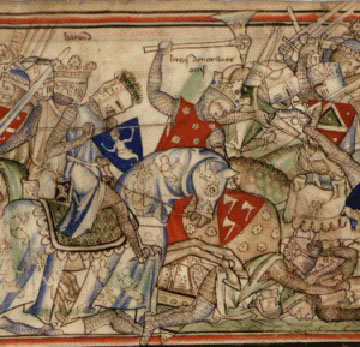
Battle of Stamford Bridge
King Harald had fallen but the battle was not over. Tostig refused his brother’s renewed offer of reconciliation and picked up the Norwegian battle standard. It took the alleged gruesome decapitation of Tostig by his own brother, Harold, to end the battle.
Harold’s celebrations were brought to an abrupt end – the king received word that Duke William of Normandy and his army had landed in England.