Harald Fairhair Halfdansson and Gyda Eriksdatter
and
Svanhild Oysteinsdatter
Harald Fairhair Halfdansson
32nd Great Grandfather
b. Abt. 850, Hedmark, Oppland, Norway
d. Abt. 933, Hogaland, Norway
Gyda Eriksdatter
32nd Great Grandmother
b. Abt. 862, Hordaland, Norway
d. Abt. 936
Svanhild Oysteinsdatter
32nd Great Grandmother
b. Abt. 880, Maere, Nord-Trondelag, Norway
d. Abt. 910
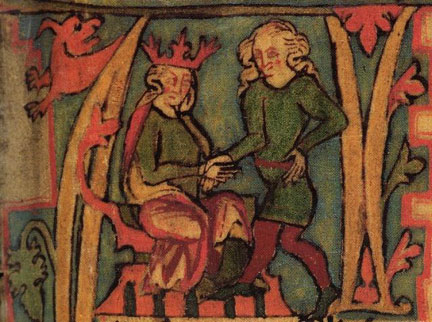
Harald Fairhair Halfdansson and Gyda Eriksdatter
We are descended from Harald Fairhair Halfdansson through two different lines, one from Gyda Eriksdatter and one from Skadi.
Harald Fairhair Halfdansson
Harald succeeded, on the death of his father Halfdan the Black Gudrodarson, to the sovereignty of several small, and somewhat scattered kingdoms in Vestfold, which had come into his father's hands through conquest and inheritance. His protector-regent was his mother's brother Guthorm.
Harald made a marriage proposal that resulted in rejection and scorn from Gyda, the daughter of Erik, king of Hordaland. She said she refused to marry Harald "before he was king over all of Norway". Harald was therefore induced to take a vow not to cut nor comb his hair until he was sole king of Norway, and when he was justified in trimming it ten years later, he exchanged the epithet "Shockhead" or "Tanglehair" for "Fairhair".
In 866, Harald made the first of a series of conquests over the many petty kingdoms which would compose all of Norway, including Vaarmland in Sweden, which had sworn allegiance to the Swedish king Erik Eymundsson. In 872, after a great victory at Hafrsfjord near Stavanger, Harald found himself king over the whole country. His realm was, however, threatened by dangers from without, as large numbers of his opponents had taken refuge, not only in Iceland, then recently discovered; but also in the Orkney Islands, Shetland Islands, Hebrides Islands, Faroe Islands and the northern European mainland. However, his opponents' leaving was not entirely voluntary. Many Norwegian chieftains who were wealthy and respected posed a threat to Harald; therefore, they were subjected to much harassment from Harald, prompting them to vacate the land. At last, Harald was forced to make an expedition to the West, to clear the islands and the Scottish mainland of some Vikings who tried to hide there.
The earliest narrative source which mentions Harald, the 12th century Islendingabok notes that Iceland was settled during his lifetime. Harald is thus depicted as the prime cause of the Norse settlement of Iceland and beyond. Iceland was settled by "malcontents" from Norway, who resented Harald's claim of rights of taxation over lands, which the possessors appear to have previously held in absolute ownership.
According to the saga sources, the latter part of Harald's reign was disturbed by the strife of his many sons. The number of sons he left varies in the different saga accounts, from 11 to 20. Twelve of his sons are named as kings, two of them over the whole country. He gave them all the royal title and assigned lands to them, which they were to govern as his representatives; but this arrangement did not put an end to the discord, which continued into the next reign. When he grew old, Harald handed over the supreme power to his favourite son Erik Bloodaxe, whom he intended to be his successor. Erik I ruled side-by-side with his father when Harald was 80 years old. Harald died three years later due to age in approximately 933.
Harald Harfager was commonly stated to have been buried under a mound at Haugar by the Strait of Karmsund near the church in Haugesund, an area that later would be named the town and municipal Haugesund. The area near Karmsund was the traditional burial site for several early Norwegian rulers. The national monument of Haraldshaugen was raised in 1872, to commemorate the Battle of Hafrsfjord which is traditionally dated to 872.
Gyda Eriksdatter
Gyda Eriksdottir of Hordaland was a legendary Norwegian Viking age queen consort, according to the sagas the first queen of united Norway.
The legend of Gyda describes the unification of Norway as somewhat of a love story. Gyda was the daughter of one of the petty kings of pre-united Norway, Erik, king of Hordaland. Princess Gyda was proposed to by Harold Fairhair, king of the petty kingdom Vestfold.
She answered that she refused to marry Harald "before he was king over all of Norway". Harald was therefore induced to take a vow not to cut nor comb his hair until he was sole king of Norway, and that ten years later, in 872, he was justified in trimming it; whereupon he exchanged the epithet "Shockhead" or "Tanglehair" for "Fairhair". He was now king of united Norway: he sent for Gyda and reminded her of the promise she made, and they were married.
Svanhild Oysteinsdatter
Svanhild Oysteindatter was born about 860. She is the daughter of Oystein Glumra Ivarsson, Earl of Oppland and Aseda Ragnvalsdatter of Vestfold.