Ragnar Lodbrok Sigurdsson and Aslaug Sigurdsdatter
Ragnar Lodbrok Sigurdsson
37th Great Grandfather
b. Abt. 760, Uppsala, Sweden
d. Abt. 840, Northumberland, England
Aslaug Sigurdsdatter
37th Great Grandmother
b. Abt. 765, Denmark
d. Abt. 842, Ringerike, Buskerud, Norway
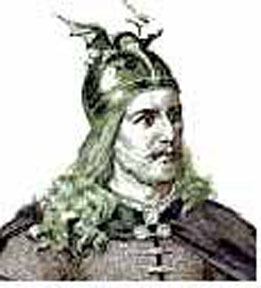
Ragnar Lodbrok Sigurdsson
Ragnar Lodbrok was a Norse ruler, king, and hero from the Viking Age described in Old Norse poetry and several sagas. Ragnar was the father of many renowned sons, including Ivar the Boneless Ragnarsson, Bjorn Ironside Ragnarsson, Halfdan Ragnarsson, Sigurd Snake-in-the-Eye Ragnarsson (37th Great Grandfather) and Ubba Ragnarsson. While these men are historical figures, it is uncertain whether Ragnar himself existed or really fathered them. Many of the tales about him appear to conflate the deeds of several historical Viking heroes and rulers.
Ragnar wanted fame, fortune, and feared his sons would eclipse his successes. As a result, he kept on the attack. France became a favorite target. Ragnar used its rivers as highways moving his men from target to target. He employed blitzkrieg-like tactics to keep the enemy off-balance. Viking mobility cancelled out any Frankish military advantage, including heavy cavalry. Lodbrok fought when the odds favored the Norse.
Ragnar’s French campaigns began in 845. The Vikings proved unstoppable, capturing Paris, and leading King Charles the Bald to pay a heavy tribute to Lodbrok. The Frankish military ran in terror after the Vikings viciously murdered their prisoners. Charles paid 7,000 pounds in silver to regain Paris. It took the Franks years to finally evict Ragnar.
Ragnar’s eviction from France may have led to his death in England. The warlord probably died in 865. He undoubtedly attacked England through the years as France. It appears Lodbrok’s luck ran out one campaign season. He shipwrecked in Northumbria and was captured by King Aella. The Anglo-Saxon king achieved a measure of vengeance by executing Ragnar Lodbrok. Aella tossed the Viking into a pit of snakes. Lodbrok allegedly warned the king of his son’s vengeance and sang a Norse hymn before succumbing to poison.
Ragnar’s son, Ivar the Boneless, led an expedition, referred to as the Great Heathen Army, aganst Aella. They captured York in 866 and killed Aella. Accounts of Aella’s demise vary. In one version, he dies in battle. On the other hand, the Vikings and Anglo-Saxon Chronicle claim Ivar captured the king and submitted him to the Blood Eagle. The Norse sometimes employed the Blood Eagle against their enemies. The executioner would cut the ribs and bend them back to look like wings. Next, he would rip the lungs out through the back. If still alive, then the Norse tossed salt into the wound for effect.
In addition to vengeance against Aella, Ragnar’s progeny also established a permanent Norse settlement in France. The Norse kept returning to the Frankish kingdom. Eventually, some decided to settle the west coast. The territory became known as the land of the Northmen, or Normandy.
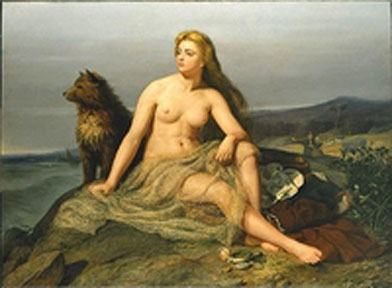
Aslaug Sigurdsdatter
Aslaug was the second wife of Ragnar Lothbrok and the mother of his younger children. Aslaug had a "gift" of seeing the future through visions or prophecies.
Aslaug was the daughter of the shieldmaiden, Brynhild, and Sigurd Fafnisbana Sigmundsson, who slew the dragon Fafnir. At the deaths of Sigurd and Brynhild, Aslaug was raised by Brynhild's foster father Heimer. At the deaths of Sigurd and Brynhild, Heimer was concerned about Aslaug's security, so he made a harp large enough to hide the girl. He then traveled as a poor harp player carrying the harp containing the girl.
They arrived at Spangereid at Lindesnes in Norway, where they stayed for the night in the house of the peasants Ake and Grima. Ake believed the harp contained valuable items and told his wife Grima. Grima then convinced him to murder Heimer as he was sleeping. However, when they broke the harp open, they discovered a little girl, whom they raised as their own, calling her Kraka ("Crow"). In order to hide her beauty, the accepted sign of her noble origins, they rubbed her in tar and dressed her in a long hood.
However, once as she was bathing she was discovered by some of the men of the Ragnar Lodbrok. Entranced by Aslaug's beauty, they allowed the bread they were baking to burn. When Ragnar inquired about this mishap, they told him about the girl. Ragnar then sent for her, but in order to test her wits, he commanded her to arrive neither dressed nor undressed, neither hungry nor full and neither alone nor in company. Aslaug arrived dressed in a net, biting an onion and with only a dog as a companion. Impressed by her ingenuity and finding her a wise companion, Ragnar proposed marriage to her, which she refused until he had accomplished his mission in Norway. She gave him four sons: Ivar the Boneless, Hvitserk, Ragnvald the Mountain-High and Sigurd Snake-in-the-Eye (37th Great Grandfather).
When Ragnar visited viceroy Oystein Beli of Sweden, Oystein persuaded him to reject Aslaug and marry his daughter, Ingeborg. On his return home, three birds had already informed Aslaug of Ragnar's plans, and so she reproached him and told him of her true noble origins. In order to prove she was the daughter of Sigurd who had slain Fafnir, she said she would bear a child whose eye would bear the image of a serpent. This happened and she bore the son Sigurd Snake-in-the-Eye. When Oystein learned of Ragnar's change of mind, he rebelled against him but was slain by Ragnar's sons at Aslaug's behest.
When Ragnar was about to undertake his ill-fated final expedition to England, his failure was due to his not heeding Aslaug's warnings about the bad condition of the fleet. When King Aella threw Ragnar into the snake pit, Ragnar was protected by an enchanted shirt that Aslaug had made. It was only when this shirt had been removed that the snakes could bite Ragnar and kill him.