Sigurd Fafnisbana Sigmundsson and Brynhild Budlasdatter
Sigurd Fafnisbana Sigmundsson
The Dragon Fafnir's Bane
38th Great Grandfather
b. Abt. 722, Ringerike, Buskerud, Norway
d. 816, Germany
Brynhild Budlasdatter
Shieldmaiden and Valkyrie
38th Great Grandmother
b. Abt. 730, Ringerike, Buskerud, Norway
d. 775, Kievan Rus
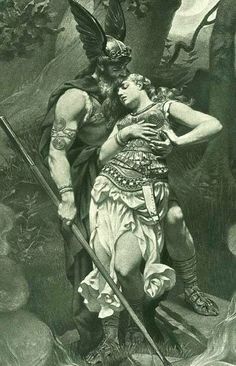
Sigurd Fafnisbana Sigmundsson
Sigurd was a legendary hero of Norse mythology, as well as the central character in the Volsunga saga. As Siegfried, he is the hero in the German Nibelungenlied, and Richard Wagner's operas Siegfried and Gotterdammerung. As Sivard Snarensven he was the hero of several medieval Scandinavian ballads.
In the Volsunga saga, Sigurd is the posthumous son of Sigmund and his second wife, Hiordis. Sigmund dies in battle when he attacks Odin, who is in disguise, and Odin shatters Sigmund's sword. Dying, Sigmund tells Hiordis of her pregnancy and bequeaths the fragments of his sword to his unborn son.
Hiordis marries King Alf of Demark, and then King Alf decides to send Sigurd to the dwarf Regin as a foster son. Regin tempts Sigurd to greed and violence by first asking Sigurd if he has control over Sigmund's gold. When Sigurd says that King Alf and his family control the gold and will give him anything he desires, Regin asks Sigurd why he consents to a lowly position at court. Sigurd replies that he is treated as an equal by the kings and can get anything he desires. Then Regin asks Sigurd why he acts as stableboy to the kings and has no horse of his own. Sigurd then goes to get a horse. An old man, Odin in disguise, advises Sigurd on the choice of horse, and in this way Sigurd gets Grani, a horse derived from Odin's own Sleipnir.
Finally, Regin tries to tempt Sigurd by telling him the story of the Otter's Gold. Regin's father was Hreidmar, and his two brothers were Otr and Fafnir. Regin was a natural at smithing, and Otr was natural at swimming. Otr used to swim at Andvari's waterfall, where the dwarf Andvari lives. Andvari often assumes the form of a pike and swims in the pool.
One day, Odin, Hoenir, and Loki of the Aesir see Otr with a fish on the banks, think him an otter, and Loki kills him. They take the carcass to the nearby home of Hreidmar, King of the Dwarves, to display their catch. Hreidmar, Fafnir, and Regin seize the Aesir and demand compensation for the death of Otr. The compensation is to stuff the body with gold and cover the skin with fine treasures.
Loki gets a net from the sea giantess Ran, catches Andvari, as a pike, and demands all of the dwarf's gold. Andvari gives the gold, except for a ring. Loki takes this ring, Andvarinaut, too, although it carries a curse of death on its bearer. The Aesir stuff Otr's body with the gold and cover its skin in gold and cover the last exposed place, a whisker, with the ring of Andvari. Afterward, Fafnir kills Hreidmar and takes the gold.
Sigurd agrees to kill Fafnir, who has turned himself into a dragon in order to be better able to guard the gold. Sigurd has Regin make him a sword, which he tests by striking the anvil. The sword shatters, so he has Regin make another. This also shatters. Finally, Sigurd has Regin make a sword out of the fragments that had been left to him by Sigmund. The resulting sword, Gram, cuts through the anvil.
To kill Fafnir the dragon, Regin advises him to dig a pit, wait for Fafnir to walk over it, and then stab the dragon. Odin, posing as an old man, advises Sigurd to dig trenches also to drain the blood, and to bathe in it after killing the dragon; bathing in Fafnir's blood confers invulnerability. Sigurd does so and kills Fafnir; Sigurd then bathes in the dragon's blood, which touches all of his body except for one of
his shoulders where a leaf was stuck. Regin then asked Sigurd to give him Fafnir's heart for himself. Sigurd drinks some of Fafnir's blood and gains the ability to understand the language of birds. Birds advise him to kill Regin, because Regin is plotting Sigurd's death. Sigurd beheads Regin, roasts Fafnir's heart and consumes part of it. This gives him the gift of prophecy.
Sigurd meets Brynhild, the Shieldmaiden, after killing Fafnir. She pledges herself to him but also prophesies his doom and marriage to another.
Brynhild Budlasdatter
In Norse mythology, Brynhild was a shieldmaiden and a valkyrie. She is a main character in the Volsunga saga and some Eddic poems treating the same events. Under the name Brunnhilde she appears in the Nibelungenlied and therefore also in Richard Wagner's opera cycle Der Ring des Nibelungen. Brynhild is probably inspired by the Visigothic princess Brunhilda of Austrasia, married with the Merovingian king Sigebert I in 567. The history of Brynhild includes fratricide, a long battle between brothers, and dealings with the Huns.
According to the Volsungasaga, Brynhild is the daughter of Budli. She is ordered to decide a fight between two kings: Hjalmgunnar and Agnar. The valkyrie knows that Odin himself prefers the older king, Hjalmgunnar, yet Brynhild decides the battle for Agnar. For this Odin condemns the valkyrie to live the life of a mortal woman, and imprisons her in a remote castle behind a wall of shields on top of mount Hindarfjall in the Alps, and curses her to sleep on a couch surrounded by fire until any man would rescue and marry her. The hero Sigurd Sigmundsson, heir to the clan of Volsung and slayer of the dragon Fafnir, enters the castle and awakes Brynhild by removing her helmet and cutting off her chainmail armour. He immediately falls in love with the shieldmaiden and proposes to her with the magic ring Andvarinaut. Promising to return and make Brynhild his bride, Sigurd then leaves the castle and heads for the court of Gjuki, the King of Burgundy.
Gjuki's wife, the sorceress Grimhild, wanting Sigurd married to her daughter Gudrun, prepares a magic potion that makes Sigurd forget about Brynhild. Sigurd soon marries Gudrun. Hearing of Sigurd's encounter with the valkyrie, Grimhild decides to make Brynhild the wife of her son Gunnar. Gunnar then seeks to court Brynhild but is stopped by the ring of fire. He tries to ride through the flames with his own horse and then with Sigurd's horse, Grani, but still fails.
Sigurd then exchanges shapes with him and enters the ring of fire. Sigurd, disguised as Gunnar, and Brynhild marry and they stay there three nights, but Sigurd lays his sword between them meaning that he does not take her virginity before giving her to the real Gunnar. Sigurd also takes the ring Andvarinaut from her finger and later gives it to Gudrun.
Gunnar and Sigurd soon return to their true forms, with Brynhild thinking she married Gunnar. However, Gudrun and Brynhild later quarrel over whose husband is greater, Brynhild boasting that even Sigurd was not brave enough to ride through the flames. Gudrun revealed that it was actually Sigurd who rode through the ring of fire, and Brynhild becomes enraged. Sigurd, remembering the truth, tries to console her, but to no avail.
Brynhild plots revenge by urging Gunnar to kill Sigurd, telling him that he slept with her in Hidarfjall, which he swore not to do. Gunnar and his brother Hogni were afraid to kill him themselves, as they had sworn oaths of brotherhood to Sigurd. They incited their younger brother, Gutthorm to kill Sigurd, by giving him a magic potion that enrages him, and he murderes Sigurd in his sleep. Dying, Sigurd throws his sword at Gutthorm, killing him.
Brynhild herself kills Sigurd's three-year-old son, and then she wills herself to die. When Sigurd's funeral pyre is aflame, she throws herself upon it. Thus they pass on together to the realm of Hel. Sigurd and Brynhild had the daughter Aslaug who married Ragnar Lodbrok.