Cantoneras of the Montauk and Cornelis Jensen Van Texel
Cantoneras of the Montauk
9th Great Grandmother
b. abt 1603, Eaton's Neck, Long Island, New York
Cornelis Jensen Van Texel
9th Great Grandfather
b. abt 1600, Isle Of Texel, North Coast, The Netherlands
Cantoneras of the Montauk is the family link to our Native American ancestry. She was born about 1603 and was the granddaughter or possibly daughter of Wyandanch Sachem of the Montauk (11th great grandfather).
During her first wedding to another member of the Montauk tribe, there was an attack by the Narragansetts, who killed her groom and brought her and 13 other women across the Long Island Sound as prisoners. Wyandanch, her father went to Lyon Gardiner for help. Out of gratitude Wyandanch gave Gardiner what is now Smithtown, the land that once belonged to his mother.
Cantoneras went on to marry a Dutchman called Cornelius Jensen Van Texel (9th great grandfather). Cantoneras' son Jan Cornelissen Van Texel (8th great grandfather) moved the family to Sleepy Hollow and joined the Sleepy Hollow Church. Jan's daughter Katrina van Tassel married Henry Abramsen Lent. They had many children. One born so dark they called him Indian Brom, the "Bram Bones" of the "Legend of Sleepy Hollow." The Headless Horseman story is a legend. However, it should be known that Wyandanch's favorite way of dispatching his enemies was beheading. Then he'd give the heads as a gift to his friend Lyon Gardener.
The Montauk
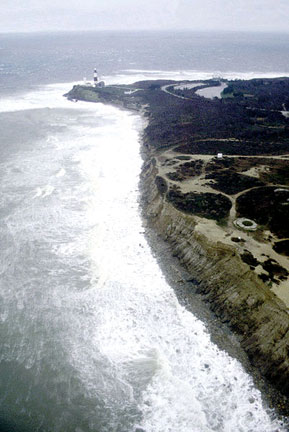
The Montauk, or Montaukett, are an Algonquian-speaking Native American group native to the eastern end of Long Island, New York. They derived great wealth from the wampompeag, or wampum, the traditional sacred shell beads, available on Long Island, but its value contributed to competition, attacks and their demise. Since it became desired for trade and payment by Native Americans and the English and Dutch colonial powers, the Montauk were raided and made politically subject by more powerful New England tribes, who demanded tribute or just stole the wampum. Introduced infectious diseases, such as smallpox, to which they had no natural immunity, and intertribal warfare, combined for great population losses, similar to that suffered by other Native American groups.
In the late 17th century, Sachem Wyandanch signed a treaty transferring much of the territory of Long Island to English settler Lion Gardiner. The Montaukett reportedly thought they were signing a treaty with the colonists for alliance and protection from the Narragansett tribe, rather than losing control of their land. This interpretation may also have been due to differing cultural concepts about land and its uses. According to legend, Sachem Wyandanch was poisoned by tribesmen in retaliation for selling the land to the colonists.
Some Montauk joined a group led by a Mohican missionary and from Long Island to escape colonial encroachment, to Oneida County, New York. Later most of the people relocated to Wisconsin. Today they are part of the Brothertown Indians movement.
Many Montauk remained in the area around Montauk, chiefly because the land was often considered inaccessible. At the end of the 19th century, the most notable Montauk was Stephen Talkhouse Pharaoh. He was known to walk 30 to 50 miles round-trip per day from Montauk to East Hampton or Sag Harbor. Various stones on his routes, part of the present-day Paumanok Path hiking trail, have been marked with this account.
In 1879, an extension of the Long Island Rail Road reached Montauk. Arthur W. Benson began buying up land in the area with an eye to future development. In the court battles that ensued, the Montauk lost their legal status and right to compensation.
The Montauk provided homes for persons of mixed white and native, black and native, and other combinations of ancestry. Many Montauks married whites and blacks outside of the tribe. As a result Montauk descendants resemble Africans, Europeans, Indians, Latinos, etc. About 500 members are currently listed on the rolls.